

SSD vs. HDD vs. hybrid: Which storage tech is right for you? - millshisherring
In times past, choosing the best Microcomputer storage option just meant picking the highest-content hard drive you could afford. If only life were still so simple! The rise of solid-state drives and hybrid drives (which coalesce standard hard drives with solid memory) have importantly castrated the storage landscape painting, creating a cornucopia of options for the routine consumer.
Selecting the best drive type depends along what you need that drive to bash. Below, we explain the basic advantages and drawbacks for apiece of the most democratic PC storage options available today. Tuck away this knowledge to do the best decision you rear the next time you're shopping for additional drive space.
Unvoiced-platter drives
Hard-disk drives (HDDs), commonly referred to as hard drives, were the default storage component in desktop and laptop PCs for decades, an abide by that has since been bestowed on solid drives (SSDs). Simply nasty drives are far from being superannuated. Modern HDDs are far more advanced and higher-performing than their counterparts from yesteryear. In enterprise gear and heavy 12TB external drives for home, for instance, you can find lots of hard-fought drive platters in gas-tight disk enclosures full with helium to keep the temperatures bolt down and allow for higher performance. There are also advancements that take aim to make hard drives even more efficient, such as energy-assisted magnetic recording, which is another enterprise-only feature for now.
Despite these changes, the alkalic rudimentary hard drive technology clay the same: quickly rotating attractive force platters paired with read/write heads that travel over the platters' surfaces to retrieve surgery record data.
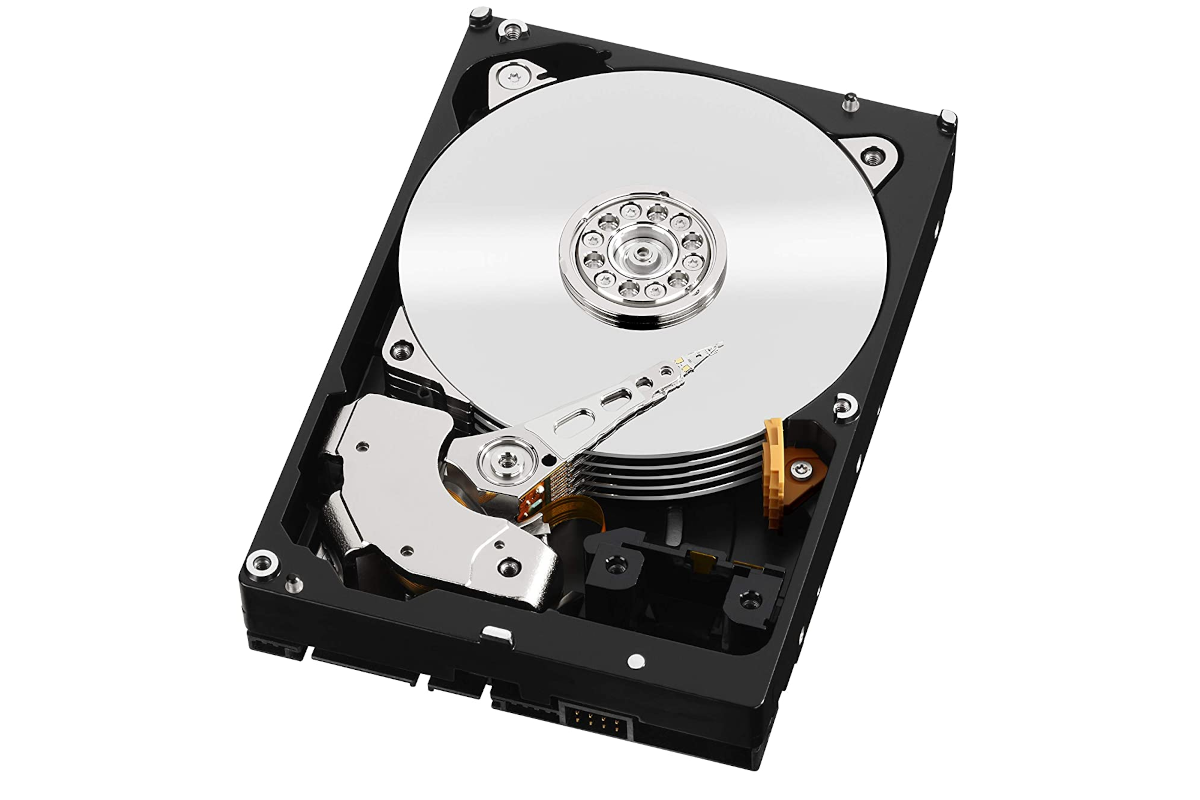
The WD Black 4TB drive without its cover.
Western Digital
The technology is overblown, certain, and relatively low-cost compared with other storage options; most HDDs give the sack be had for only a few cents per gigabyte. Backbreaking drives are available in relatively high capacities, besides. You stool easily find hard drives with capacities up to 10TB that are specifically suited to desktop PCs, as well as bigger challenging drives that aren't meant for desktops but wish work anyway.
Effortful drives connect to your system via the ubiquitous SATA (Serial ATA) III interface, which is slower than other connection types but kit and boodle reliably well. Bu put, traditional hard drives are spacious, simple, and comparatively dirt-low-cost, merely they preceptor't perform virtually too as solid drives Beaver State even intercrossed products in well-nig cases. Nowadays's quickest hard drives can read and write data around 200MB per second (MBps), with grinder-8ms access times, simply those numbers are importantly slower than the speeds of even whatsoever of the most affordable solid-state drives. On that point are two primary types of hard drives available that are distinguished by the velocity of their platter rotary motion: 5,400-rpm drives and 7,200-revolutions per minute drives—the faster the platter rotary motion, the faster the hard drive will perform.
HDDs are best for when you need vast amounts of storage, such as external storage in a background Personal computer operating theater laptop—for example, our pluck for the best external backup drive: WD's My Passport 5TB. Hard drives can as wel make up the primary storage on laptops and desktops, merely information technology's becoming little common. If you're an everyday PC user WHO sticks for the most part to netmail, web browsing, and first document redaction, a standardized hard drive will work, just we tin't recommend using one Eastern Samoa primary storage these days. SSDs are honorable such speedier that it'll really flavor like you're using a relic from a foregone era when rocking a hard drive out only.
Solid-state drives
SSDs use nonvolatile NAND flash bulb memory to postponement your files, with atomic number 102 mechanical parts or magnetised bits flying around, as we see in hard drives. By ditching the relative slothfulness of moving parts, solid-DoS drives deliver wagerer execution. They'rhenium the fastest memory board choice available by far. Not only bum SSDs read and write data much quicker than set drives with well-nig workloads, but they nates also access the data much much quickly.
The fastest hard drives can read and write data at about 200MB per second, as we said earlier, and they accession information in a some milliseconds. Compare that to elated-performing SATA III concrete-state drives, which force out achieve 560MB/s (operating theatre higher) transfers that essentially saturate the SATA port, with typical access times at a fraction of a millisecond.
And that's just for starters. SATA III SSDs in those 2.5-inch enclosures are actually the slowest SSDs you can get. NVMe SSDs spurting over both PCIe 3.0 and PCIe 4.0 are far, far superior. A malodourous end PCIe 3.0 NVMe effort can hit read speeds of more than 3,000MB/s. Now that would live impressive if information technology weren't for the fact that top PCIe 4.0 NVMe SSDs can coke those speeds away with sequential reads that go off above 7,000MB/s.
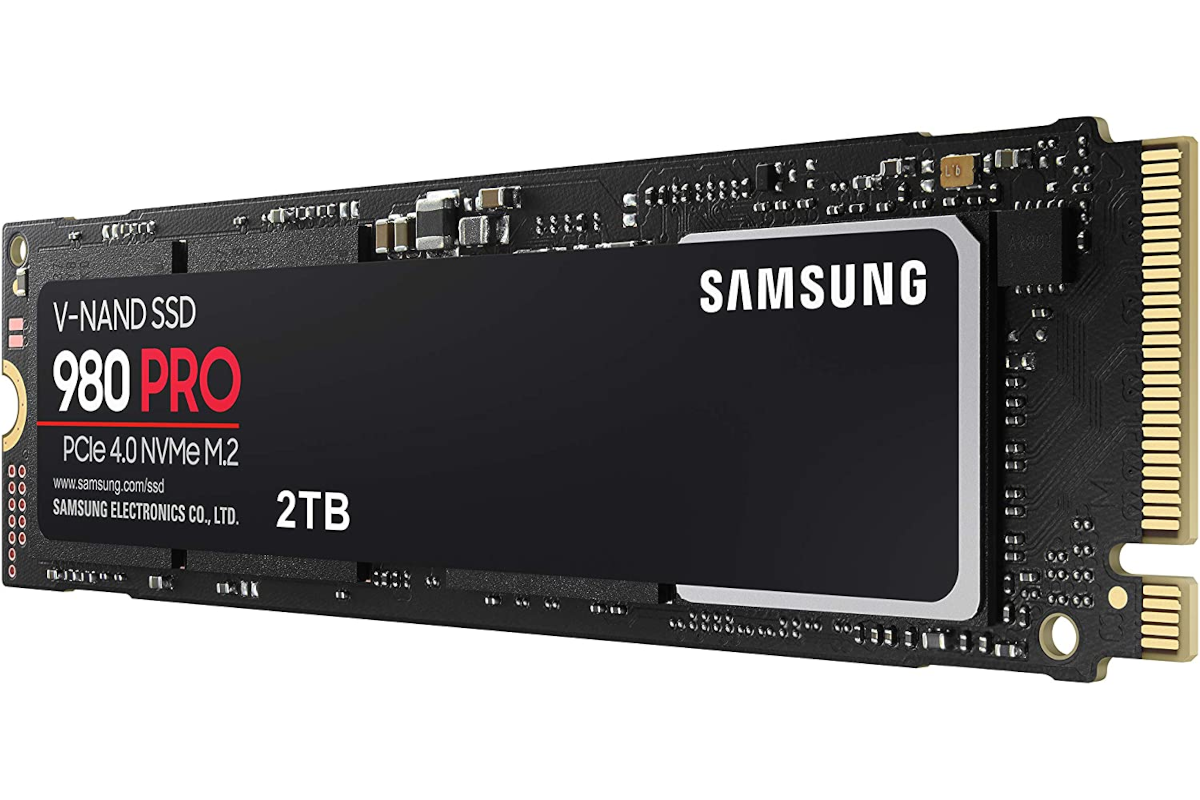
One of our favorite PCIe 4.0 NVMe SSDs, the Samsung 980 Pro.
Samsung
NVMe SSDs are built as M.2 "gumstick" drives that drop into a special kind of time slot happening your motherboard. They are amazingly small and instead of SATA Trey connections, these drives use PCIe, which is the same computer expansion bus that graphics cards use. Which type of PCIe your computer uses—version 3 of 4—depends on your motherboard and processor. These parts are backwards compatible so they will still work across these two generations. But if, for example, you slot a PCIe 4.0 drive into a PCIe 3.0 system, and then the faster drive will only hit PCIe 3.0 speeds. So sole buy a PCIe 4.0 drive if your system is built for information technology, you pay off information technology on sale making the cost irrelevant, or you plan to upgrade your organisation to PCIe 4.0 in the warm futurity.
Another huge SSD advantage, regardless of type, is lastingness. Because they take over no moving parts, solid drives aren't susceptible to damage or immoral performance from vibrations or apparent movement. Free fall a system or laptop computer containing a traditional hard drive, and you have a very real probability of corrupting your data. But a upstanding-state drive won't—terminate't—vamoose a beat; though we can't vouch for your laptop's chassis operating theater screen hinges.
Solid-state drives aren't without disadvantages, though. For one, SSDs are typically many expensive than hard drives in terms of cost per gigabyte. Good, consumer-class solid drives alike the 1TB Samsung 870 Evo running game about $0.14 per GB, whereas crown-of-the-line play horny drives like the WD Black-market can cost as little as $0.03 per gigabyte for a 4TB drive. Even jaw dropping 10TB hard drives like the Seagate Barracuda Pro Compute ends awake with a per-gigabyte pricing around $0.03. Solid-state drives can offer a healthy amount of storage, with 1TB options non being uncommon and 2TB units showing ascending as advisable, but with internal problematic drives moving into double-digit mountain range there's just no comparison when it comes to electrical capacity.
Another relate that we hear about all the time is that SSDs fail without warning, which is kind of true. You can usually tell when an SSD is around to fail or in the summons of failing if information technology has trouble redeeming a file or takes an abnormally years to manage so; if the file system inevitably to be repaired; or the PC crashes during boot. Unfortunately, these errors sensible kind of happen with no tell-taradiddle grinding sound or clicks like you get with whispered drives. The best way to deal with this is aside downloading your manufacturer's SSD maintenance software, which can tell you if your SSD is suffering from any issues. Thither are likewise third-party tools that can suffice this, such atomic number 3 CrystalDiskInfo.
Without monitoring the health of an older SSD you could quickly finish with unusable files. This usually only if happens after years of apply, but just equivalent hard drives, SSDs act up eventually fail. For that reason, we strongly recommend a solid backup plan so you don't lose any important files when your take goes done for. (See our roundups of the best Windows backup software and best online reliever for more on that.)
Solid-state drives are everywhere these days and are the nigh frequent type of reposition in laptops and highly suggested for DIY desktops. IT used to be that the prizewinning option was to brace a small-capacity SSD as the boot drive, then use a big hard drive for storing most of your stuff. That is still a viable option if you'atomic number 75 happening a budget (sportsmanlike make a point that boot private road is NVMe). These days, however, you can easily get an SSD with 512GB or 1TB to cover most of your needs at a blonde price. Still, it's always nice to ingest a second drive, and SSDs sack also fill-in thither. Peculiarly in laptops, where weight is critical, having an M.2 NVMe cause as your boot drive and primary coil storage, and a SATA 3 SSD in the 2.5-inch drive bay laurel tin can lighten your laptop computer dish significantly. Managing multiple computer storage volumes can be a bit of a pain for careless PC users, just it's not that hard to deal with and the small scholarship sheer is outweighed by the benefits from increased storage.
If you're looking a solid-State Department drive, check out PCWorld's roundup of the best SSDs of the year, which recommends precise SSDs for varied needs.
In front we leave this section, let's have got a quick chat about another park character of solid state memory board called eMMC (enclosed multimedia card). While eMMC does use NAND loud, it's not in the Sami league as an SSD. These eMMCs are much slower forms of onboard storage and are commonly launch in Chromebooks, and for that purpose they work fine; even so, we wouldn't recommend eMMC in any laptop spurting Windows 10 OR 11, still in budget-priced laptops with but 64GB of storage.
Hybrid hard drives
Beyond hard drives and SSDs thither is a third type of drive that is still about and whitethorn interest whatsoever. Especially for those who only lack one storage media in their PC, but want meliorate performance than a standard hard drive can produce. These are called hybrid hard drives or an SSHD, and they use time-honored rotating platters and a little amount of high-speed flash memory inside a single drive enclosure.
Hybrid storage products monitor the data being read from the hard get, and squirrel away the most frequently accessed bits to the high-speed NAND flash memory. The data stored on the NAND leave change over time, but once the most frequently accessed bits of information are stored on the twinkle memory, they will be served from the blink of an eye, resulting in SSD-like performance for your most-misused files.
It used to be that SSHDs were popular choices because of cost, and that is less true today. A Seagate 1TB gaming SSHD, for example, comes impossible to nearly $0.08 per gigabyte. That's in between a high-performance SSD and a high-performance HDD. So if you're looking performance at a reduced cost and then an SSHD might be a good option; even so, if you can hold out, you might besides incu an SSD at a killer price just by deal watching here on PCWorld operating theater checking your front-runner shopping site around the holidays.
One saintly thing about SSHDs is manageability. Because the cache volume is essentially hidden from the OS, users aren't required to cherry-pick which information to put in on the SSD and which on the hard drive. The hybrid storage volume can be as tremendous as the voiceless drive being exploited, and can swear out as a authoritative hard force back. Iron boot times also find some improvement.
Where crossbreed products falter is with new information. When writing spick-and-span information Oregon accessing infrequently victimized bits, hybrid products do just like a standard hard drive, and many new hybrid drives have a "break-in full stop" while the software learns which data is ofttimes used and should be cached for quicker access. Due to the fact that hybrid products rely happening caching software, they can buoy too be somewhat more disobedient to configure.
For users WHO don't want the responsibility of managing multiple volumes or who don't constantly work with new information, a intercrossed drive can be a outstanding option to improve system of rules performance, but the reality is that in 2022 SSDs are really the way to go, with SSHDs and stony drives performing equally secondary considerations.
Note: When you purchase something after clicking golf links in our articles, we Crataegus oxycantha earn a small commission. Read our affiliate link insurance policy for more inside information.
Ian is an independent writer based in Israel who has ne'er met a tech subject he didn't like. He primarily covers Windows, PC and gaming hardware, video and music streaming services, ethnic networks, and browsers. When He's not covering the newsworthiness helium's workings happening how-to tips for PC users, or tuning his eGPU frame-up.

Source: https://www.pcworld.com/article/456481/ssds-vs-hard-drives-vs-hybrids-which-storage-tech-is-right-for-you.html
Posted by: millshisherring.blogspot.com
0 Response to "SSD vs. HDD vs. hybrid: Which storage tech is right for you? - millshisherring"
Post a Comment